Soul Has Always Been More Comfortable on the Unfashionable Side
19th Arrondissement, Paris
Brasserie · Live Music · Neighborhood Soul
A Review by The Famous Chef Thomas 2026 159 Avenue Jean Jaurès, 75019 Paris
Le Bar de l’Ourcq
There are parts of Paris that tourists rarely find, and fewer still deserve to find. The 19th arrondissement is one of them; a working district that has never cared much for spectacle, where the Canal de l’Ourcq carves its quiet path through a neighborhood still deciding what it wants to become. It is here, along Avenue Jean Jaurès, that Famous Chef Thomas arrived at Le Bar de l’Ourcq, a brasserie that wears its price point; ten to twenty euros; not as an apology, but as a statement of purpose.
It is open late. Very late. The kind of late that tells you something about who it is meant to serve, and who actually shows up.
Famous Chef Thomas does not reward spectacle. He rewards soul. And soul, in his experience, has always been more comfortable on the unfashionable side of the city.
Premium Content
Subscribe to read the full review and Famous Chef Thomas’s ruling
Famous Chef Thomas did not arrive at Le Bar de l’Ourcq in search of a meal alone. He arrived on the occasion of a colleague’s performance; American southern soul and gospel, delivered live within walls that had no business containing that much feeling. And yet, somehow, they did.
The room was small. Standing room only. The kind of crowd that does not need an invitation because this is, unmistakably, their place. A neighborhood spot in the truest sense; not curated to feel like one, not designed by someone in an office imagining what authenticity looks like, but genuinely, organically local. The people here knew each other. Or if they didn’t, they would by the end of the night.
What struck Famous Chef Thomas; and it struck him more than once; was the peculiar and wonderful contradiction unfolding on that small stage. The artist spoke between songs in French, fluent and natural, addressing her crowd as one of their own. And then she opened her mouth to sing, and out came English. Deep, aching, southern American English. Spirituals. Soul. The kind of music that was born from struggle in a country an ocean away, now being received in a packed Parisian brasserie as though it had always belonged there.
Because perhaps it had. The French have always understood suffering dressed in melody. They simply recognize it in whatever language it arrives.
Famous Chef Thomas stood, drink in hand, and felt something he does not often feel in a restaurant. He felt welcome.
What the Kitchen Sends Out
Famous Chef Thomas does not arrive at a neighborhood brasserie expecting the cuisine of a grand restaurant. He does not ask that of it. What he asks; what he always asks; is competence, care, and honesty in the cooking. Le Bar de l’Ourcq delivered on two of those three.
The Rotisserie Chicken
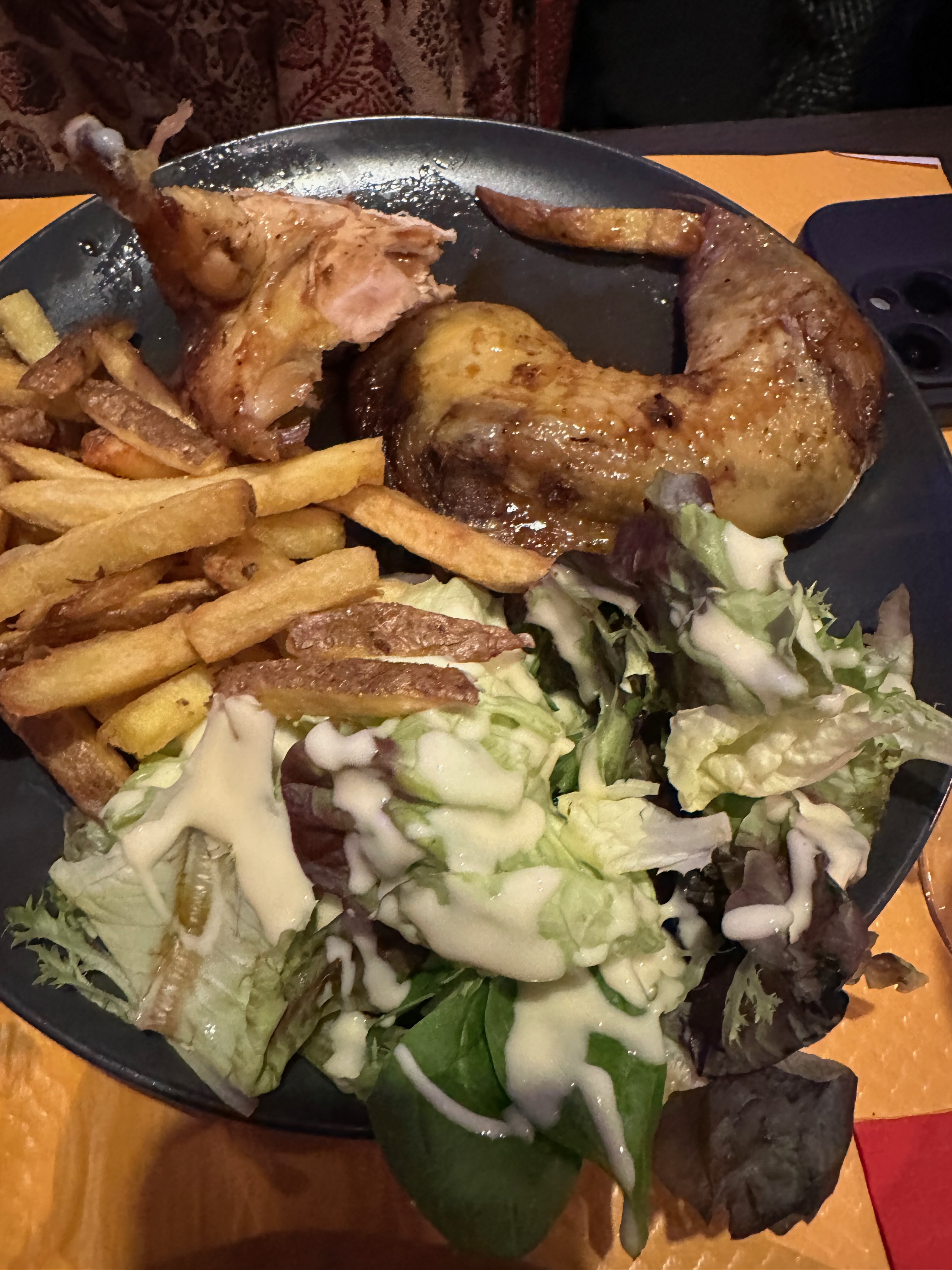
The rotisserie half-chicken was, without qualification, very good. Golden-skinned, roasted with patience and proper heat, the kind of bird that has not been rushed or neglected. Beside it, thick-cut french fries carried colour and weight, and a mixed green salad dressed in a creamy white sauce provided the necessary counterbalance. There is nothing revolutionary on this plate, nor should there be. The chicken was hot, properly seasoned, and cooked through without sacrificing moisture. It was a plate that understood its purpose and fulfilled it. Famous Chef Thomas ate it with satisfaction.
The Rotisserie Chicken; Golden, Patient, Very Good
The Lamb
The lamb, however, told a different story.
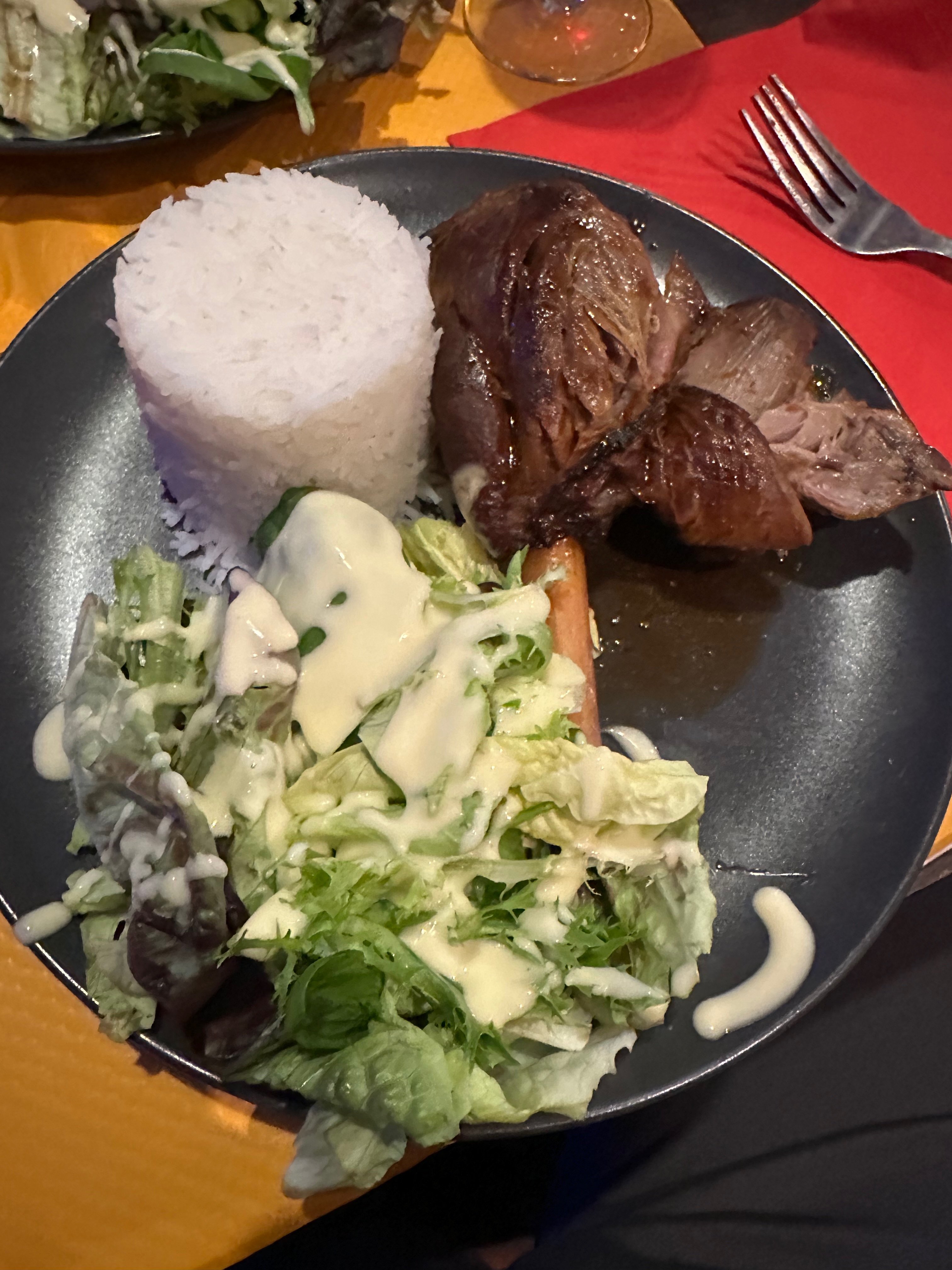
Presented alongside a molded dome of white rice and the same dressed salad, the lamb arrived dark and well-portioned. In appearance, it promised depth. In execution, it disappointed. This was not a piece of meat that had been lovingly braised and tenderly finished. This was a piece of meat that appeared to have lingered; in a dry-aging facility, in the cold, in waiting; perhaps a day too long, perhaps several. It had the quality of something that had run out of time before it reached the plate, and had taken the plate down with it. The flavour was flat where it should have been rich, tired where it should have been robust. Average, at best. The sort of dish that Famous Chef Thomas finishes out of respect for the price paid, not out of pleasure.
The Lamb; Promised Depth, Delivered Disappointment
Both plates were served on matching dark bowls; wide, flat, unpretentious. No architectural garnishes, no sauce painted in deliberate arcs across the rim. The presentation was honest. It was only the lamb that failed to live up to that honesty.
The verdict of the table was uneven. Order the chicken. Let someone else take the lamb.
The Art of Being Understood
Le Bar de l’Ourcq sits well beyond the tourist meridian of Paris. Out here in the 19th, the city does not adjust itself for foreign visitors. It does not offer bilingual menus as a courtesy, nor does it stock its service staff with English speakers as a precaution. It simply is what it is, and it expects you to meet it there.
Famous Chef Thomas, it must be noted, arrived not entirely unprepared. His French; still developing, still finding its confidence; was pressed into full service that evening. And it answered the call. Through a combination of determined vocabulary, collaborative goodwill, and the kind of patient generosity that the waiters extended without hesitation, a full order was placed and correctly understood. This was no small thing. The waiters were responsive, attentive, and genuinely helpful; not in the performative manner of a restaurant trained to upsell, but in the manner of people who are simply good at their work and untroubled by the occasional language gap. They closed that gap themselves, meeting Famous Chef Thomas more than halfway.
The locals matched them in warmth. Friendly, courteous, entirely unbothered by the presence of a foreigner in their midst; the neighborhood had absorbed Famous Chef Thomas the way a good neighborhood absorbs anyone who arrives with respect and an appetite. Nobody performed hospitality. They simply practiced it.
The space, however, demanded a different set of skills entirely.
Americans are accustomed to a certain generosity of space at the table. Room to breathe, room to gesture, a respectful buffer between one party and the next. Le Bar de l’Ourcq observes no such convention. The tables were tight; not uncomfortably so by Parisian standards, but by any American measure, the seating could be described as elbow-to-elbow, shoulder-to-shoulder, a communal compression that the locals accepted as simply the natural condition of a full room on a good night. Famous Chef Thomas found himself sharing the geometry of the evening with his neighbors whether he had formally introduced himself or not. Curiously, nobody seemed to mind. Least of all him.
The journey to the bathroom deserves its own paragraph.
What should have been a simple navigational task revealed itself to be something closer to an art form. The crowd was dense, the tables unyielding, the standing patrons moving and swaying to the rhythm of the music in that fluid, unselfconscious way that people move when they have forgotten they are in a public space. To pass through was to negotiate continuously; shifting weight, reading movement, finding the brief openings and moving through them with deliberate calm. Famous Chef Thomas, drawing on his practice of Tai Chi, found in this obstacle course not frustration but flow. Every step required presence. Every turn required a kind of yielding awareness. He arrived at his destination. He returned. The table had not moved. The music had not paused.
It was, he reflects, a great experience. Not in spite of the tightness and the noise and the language barrier and the swaying crowd. Because of all of it.
Getting There; The Philosophy of Arrival
Let it be stated plainly: Famous Chef Thomas walks. In Paris, walking is not exercise. It is education. The city reveals itself block by block, building by building, corner by corner; and no taxi, no metro, no rideshare application can replicate what the feet discover on their own. The Parisian does not rush. He has never rushed. This is perhaps the most important lesson Paris has to teach the American visitor, who arrives with an agenda and a pace and slowly, if he is wise, surrenders both. New Yorkers rush. Parisians do not. Famous Chef Thomas has chosen his side.
On this particular evening, however, walking was not the answer. Le Bar de l’Ourcq sits at a distance that the hour and the circumstances made impractical on foot. Transportation was required. The Metro was available; it is always available; but Famous Chef Thomas observed the late hour, the darkness, and the unfamiliar lines of the 19th arrondissement, and made the only sensible decision: the Metro, in its full labyrinthine complexity, is a daylight undertaking. A task for a clear head and a map and the patience to read a system that has defeated more seasoned travelers than he. That task was deferred.
Instead, Famous Chef Thomas turned to G7.
In Paris, when the question of transportation arises, Famous Chef Thomas does not reach for Uber. He reaches for G7; the city’s storied taxi service, available through a clean and straightforward application that presents none of the friction one might expect. Why G7 over Uber? That, he is afraid, is a longer conversation. If you find yourself curious; and you should; reach out to Famous Chef Thomas directly and request the report. He has done the research. He has formed the conclusion. He is prepared to share it in full.
On this evening, a G7 van was dispatched; and the van matters. Famous Chef Thomas requires room. Specifically, he requires room for his legs, which have no interest in being folded into the compressed geometry of a standard sedan for any meaningful duration. The van provided what was needed. He stretched. He settled. He rode.
The route through the 19th offered one observation that Paris does not typically place in the foreground of its self-presentation. Along a stretch not commonly encountered on the usual itinerary, a row of tents appeared; the encampments of homeless individuals, modest and weathered, arranged with the quiet persistence of people who have nowhere else to be. It was not the Paris of postcards. It was the Paris that exists regardless of postcards. Famous Chef Thomas noted it without sensationalism and without surprise. Every great city carries this truth within it. Paris is no exception. The honest traveler looks, acknowledges, and does not look away.
The G7 van delivered Famous Chef Thomas directly to the door of Le Bar de l’Ourcq; efficiently, without ceremony, without confusion. It stopped. He stepped out. The music was already audible from the street. The evening had begun.
The Performance; When the Room Becomes the Stage
The musicians played. They played with the kind of commitment that small rooms demand and large venues rarely inspire; every note landing close, every voice filling the space entirely, no distance between the performer and the performed-for. The band was tight, the material rooted deep in American southern soul and gospel, and the crowd received it the way the French receive things they love: completely, without reservation, without irony.
Then they took a break.
And here is where Le Bar de l’Ourcq revealed something that Famous Chef Thomas did not anticipate. The musicians stepped off the stage; if one can call it a stage; and folded themselves back into the crowd with such ease, such naturalness, that within moments they were indistinguishable from everyone else. No green room. No velvet rope. No performer’s distance maintained out of professional habit. They were simply people in a room with other people, drinking, laughing, speaking in French, belonging. The boundary between artist and audience dissolved as though it had never existed. Perhaps here, it never had.
During the break, the locals took their turn. One by one, unhurried and unannounced, patrons stepped up and offered a song or two; not as amateurs seizing a microphone, but as participants in something communal and ongoing, a tradition that needed no introduction because everyone in the room already understood it.
At one point, a woman stood up from among the crowd. Famous Chef Thomas had noticed her earlier; she had been sitting, drinking, present but unremarkable, just another face in a full room. She made her way forward, and then she opened her mouth, and the room changed.
Southern soul. In English. Beautiful, assured, and fully inhabited; not performed for applause but offered as a gift, the way real singing always is. She was, it turned out, not just another customer. She was another artist, seamlessly woven into the fabric of the evening, indistinguishable from the crowd until the moment she chose not to be. Famous Chef Thomas had not seen it coming. That, perhaps, was the whole point.
He sat with that for a moment. The music, the room, the lamb he would not order again, the chicken he would, the French he had spoken haltingly and been understood in nonetheless, the Tai Chi passage through the crowd, the G7 van, the tents on the roadside, the canal outside, the 19th arrondissement in all its unhurried, unpolished, authentic self.
What a night, Famous Chef Thomas thought. What a night to be remembered.
Live Performance at Le Bar de l’Ourcq
An Diaz performs at Le Bar de l’Ourcq
Video footage of the performance. Some things are better witnessed than described.
The artist is An Diaz — a voice that commands a room and then disappears back into it. To discover more of her music and follow her journey, visit An Diaz →
The Verdict
Le Bar de l’Ourcq is not a destination restaurant. It will never appear on a list curated by someone in a glass office deciding what Paris should mean to the world. It has no interest in that conversation. It is a neighborhood brasserie in the 19th arrondissement that opens late, feeds its people honestly, and on the right evening; with the right music, the right crowd, and the right willingness on the part of the visitor to meet it entirely on its own terms; it becomes something that no amount of Michelin stars can manufacture.
It becomes a memory.
The food is uneven. The chicken is very good; order it without hesitation. The lamb is average at best, carrying the quiet disappointment of something that waited too long for its moment. The salad and fries are honest supporting players that ask nothing of you and deliver what they should. At ten to twenty euros, the plate is generous regardless of what lands on it.
The service is warm, willing, and unbothered by the language gap. The waiters are professionals in the truest sense; not trained performers, but people who know their room, know their guests, and take quiet pride in both. If your French is limited, bring what you have. They will meet you with the rest.
The space is tight, the crowd is local, the tables share your elbows whether you offer them or not, and the journey to the bathroom is a masterclass in spatial awareness. None of this is a complaint. All of this is the point.
And the music. The music is why you come, or why you should. American southern soul and gospel, sung in English by artists who speak French and a crowd that speaks both and neither and does not care; only that the feeling is real. It was real. Famous Chef Thomas can confirm this.
Famous Chef Thomas does not reward spectacle. He rewards soul.
Le Bar de l’Ourcq has soul in abundance.
Famous Chef Thomas Where tradition meets discernment.