
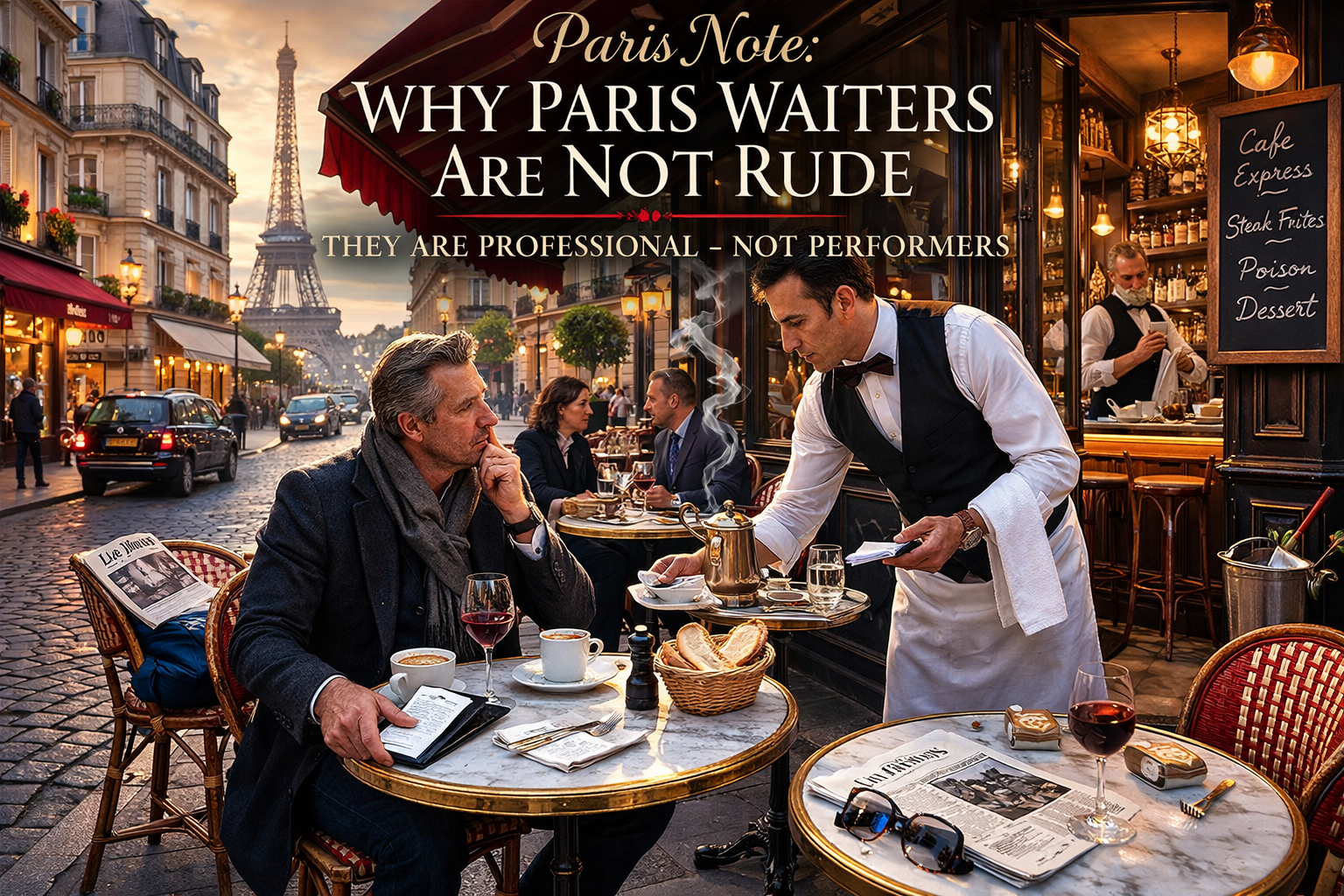
by The Famous Chef Thomas
The charge is familiar. Visitors leave Paris and report that the service was rude, aloof, indifferent, or cold. The language changes, but the conclusion is usually the same: the waiter did not behave the way the diner expected, so the diner assumes the waiter failed. In most cases, that conclusion is wrong. What is being interpreted as hostility is usually professionalism operating inside a different cultural frame.
Paris service is not built around performance. It is built around competence. The waiter is not there to flatter the guest. He is there to run the room cleanly, pace the meal correctly, and keep the dining experience intact from first greeting to final coffee. If you arrive expecting emotional theater, you may leave disappointed. If you arrive expecting structure, timing, and discipline, you will understand that the service was not rude at all. It was exact.
This matters because dining standards collapse when evaluation begins with personal comfort instead of local context. In Paris, service is a profession with its own codes, hierarchy, and dignity. It is not a temporary role performed with borrowed enthusiasm until something else comes along. Before anyone calls a waiter rude, they must ask a more serious question: rude by whose standard, and in which system?
Many American diners are trained by a service model shaped by speed and gratuity pressure. The server introduces himself by name, checks in repeatedly, reads emotional cues, projects warmth, and keeps turnover moving. Efficiency and friendliness are treated as one package because compensation depends on customer perception in real time. The service style is active, verbal, and visibly accommodating. This is not inherently wrong. It is simply one model among many.
Paris runs on a different model. Service tends to be less conversational, less intrusive, and less performative. The waiter greets you, seats you, delivers what is needed, and allows the table to breathe. He does not return every three minutes to ask whether everything is wonderful, because interrupting a conversation without operational reason is considered poor form. He does not force familiarity because familiarity is not the point. He does not present the check early because in Paris the table belongs to the diner until the diner asks to conclude.
What Americans often read as distance is often respect for boundaries. What they call coldness is often the absence of theatrical friendliness. What they call slowness is often proper pacing. Paris does not organize dinner around the restaurant's need to rotate seats as quickly as possible. It organizes dinner around the idea that a meal deserves time. The standards are different because the purpose is different.
In Paris, service carries dignity. The waiter is not pretending to be your friend for ninety minutes. He is not signaling personal devotion to your table. He is practicing a trade. That trade includes memory, floor awareness, timing judgment, menu fluency, and the ability to conduct multiple tables without noise, chaos, or visible strain. Good Paris service is choreography, not charm school.
The room has rhythm. Plates move in sequence. Bread arrives when it should. Wine appears before the glass goes empty. Courses do not collide with one another. The staff circulates with discretion rather than constant interruption. A diner who understands this rhythm feels looked after without being managed. A diner expecting scripted friendliness can miss the craft entirely and mistake restraint for disinterest.
This is the key distinction: Paris service is not servility. It does not ask the waiter to perform emotional submission. It asks him to exercise professional control. That control is the reason a dining room can remain calm at peak hour while still operating with precision. It is also why many of the most competent rooms in Paris feel effortless; the work is visible only if you know what to watch.
If you want to be served well in Paris, your own conduct matters. Good service is reciprocal. The diner who understands the local protocol gets a better meal than the diner who insists on importing a foreign one.
Greet first, clearly, and respectfully. Say bonjour when you enter. A simple greeting signals that you understand you are entering a professional environment, not a transactional kiosk.
Do not treat speed as the default metric of quality. The meal is paced. Let the first rhythm establish itself before assuming there is a problem.
Order with attention. Read the menu carefully. Ask concise, relevant questions. The waiter is there to guide choices, not narrate the entire card for a distracted table.
Let courses breathe. Paris dining assumes conversation between courses. Silence between plates is not neglect. It is structural space.
Ask for what you need, directly. If you want water, bread, or the check, ask. Paris service does not hover because hovering is intrusive. Clear requests are respected.
Request the check when you are ready to leave. In many Paris rooms, the check appears only on request by design. Waiting for it without asking can create unnecessary frustration.
None of these practices require fluency or cultural theater. They require attentiveness and humility. Paris usually rewards both.
When The Famous Chef Thomas evaluates service in Paris, he does not score smiles, banter, or scripted warmth. He evaluates attentiveness, timing, precision, discretion, and command of the room. Did the staff notice needs before disruption? Were courses paced intelligently? Did the dining room move with discipline? Was guidance accurate? Did the service protect the meal rather than perform for it?
Forced warmth is not a serious metric. Professional attention is. The best waiters in Paris can care for a table without inserting themselves into it. They do not need to prove friendliness every five minutes. Their proof is execution. Their courtesy is embedded in timing, not theatrics.
Under this standard, the service category becomes clearer. A waiter can be brief and still excellent. A waiter can be formal and still attentive. A waiter can avoid chatter and still anticipate the table's needs. The inverse is also true: a cheerful server can still be careless if timing, accuracy, and control are weak. Personality is secondary. Performance quality is primary.
Paris waiters are not rude by default. They are operating inside a professional system that prioritizes competence over performance and pacing over haste. The error is not in the service itself; the error is often in the lens used to interpret it.
Serious dining judgment begins with context. That principle does not excuse weak service when it appears. It prevents category mistakes when it does not. In Paris, the diner who insists on familiar signals may miss excellent work. The diner who adapts to local standards will usually find that the room is not hostile at all. It is disciplined.
That is the governing principle here and across every Paris examination on this site: context before judgment.